

Victorian Roofs and Parapets: The Problems You Can't See from the Street

Stand outside a Victorian mansion block and you often can't see the roof at all. That's the first thing to understand about it.
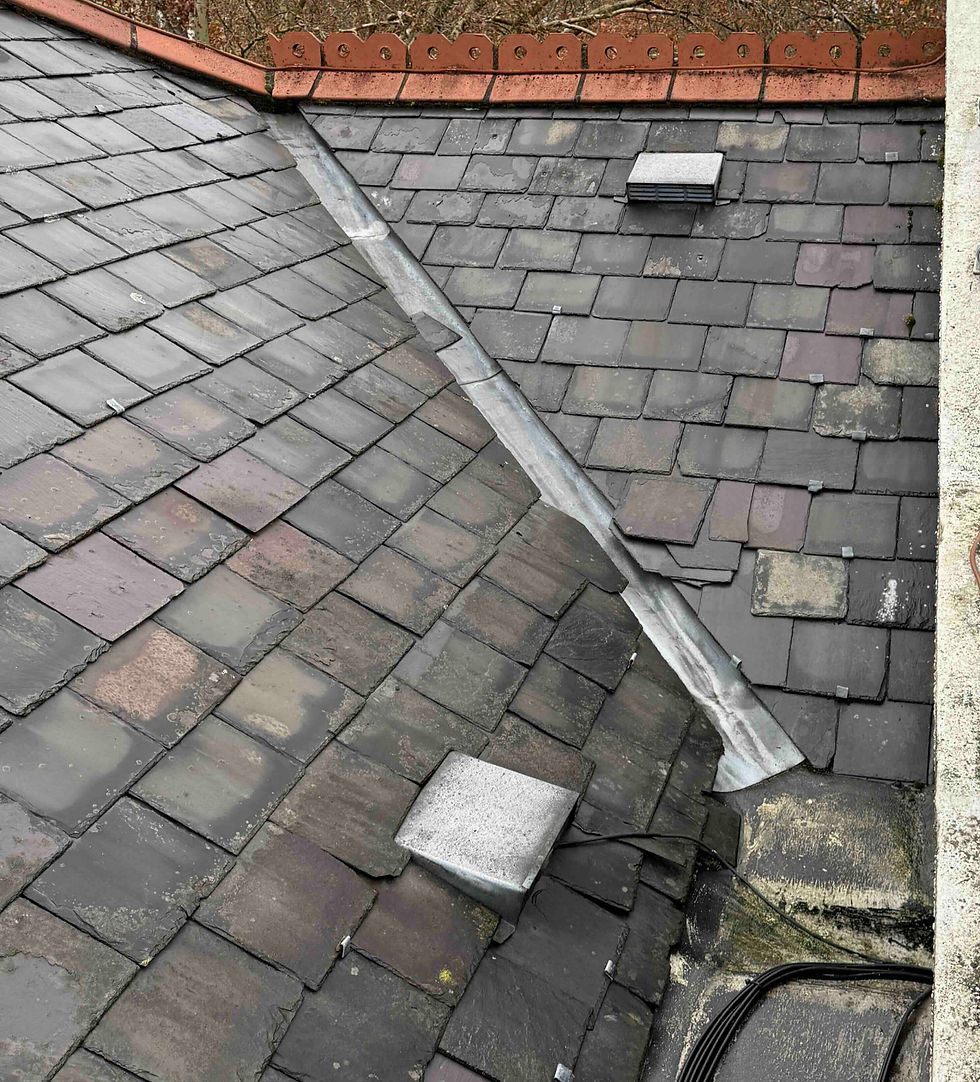
Many Victorian blocks hide their roofs behind parapets — the walls that continue upward past the top floor to a decorative coping. Behind them may sit pitched slate roofs, flat leaded areas, and most importantly, parapet and valley gutters: internal channels, often lead-lined, that collect all the rainwater from the roof slopes and carry it to outlets and hoppers. Some blocks have "London" or butterfly roofs, whose slopes drain inward to a central valley. The consequence is the same either way: the drainage runs inside the building's footprint, above occupied flats — not off the eaves into an external gutter, as on a modern block.
This is an elegant system, and when maintained, it works beautifully. But its failure modes are unforgiving:
Blockage has nowhere safe to overflow. Leaves, moss, or a dead pigeon in a parapet gutter doesn't cause water to spill harmlessly down the façade — it backs up over the gutter lining and into the top-floor ceilings. A £200 clearance neglected becomes a five-figure claim.
Lead moves. Lead expands and contracts daily with temperature. Victorian plumbers understood this and laid it in limited lengths with stepped joints and drips. Replace it with a single long, welded run — or over-fix it — and thermal fatigue splits it within years. Repairs must respect the original detailing, not just the material.
Slate fails nail by nail, not all at once. Good Welsh slate lasts 150 years or more, but the iron nails fixing it corrode first — "nail sickness". Slipped slates can often be refixed individually for decades before wholesale recovering is genuinely needed. Knowing which stage a roof is at is worth hundreds of thousands of pounds to a service charge.
Parapets are the most exposed masonry on the building. Weathered on both faces, saturated from above through failed coping joints, and often restrained by embedded iron cramps that crack the stone as they corrode, parapets deteriorate faster than any other wall — and shed debris onto the street when they do.
Why specialist management matters: none of this appears on a tick-box inspection from ground level. It takes someone who knows where the gutters actually run, insists on clearing them on a proper cycle, checks copings and flashings from roof level, and can tell a slate roof needing a repair from one needing replacement. That knowledge is the difference between a roof maintained for £2,000 a year and one "renewed" for £400,000 — and between a dry building and a saturated one.
At Bovellan, that's precisely the knowledge we bring to every roof we manage.


Comments